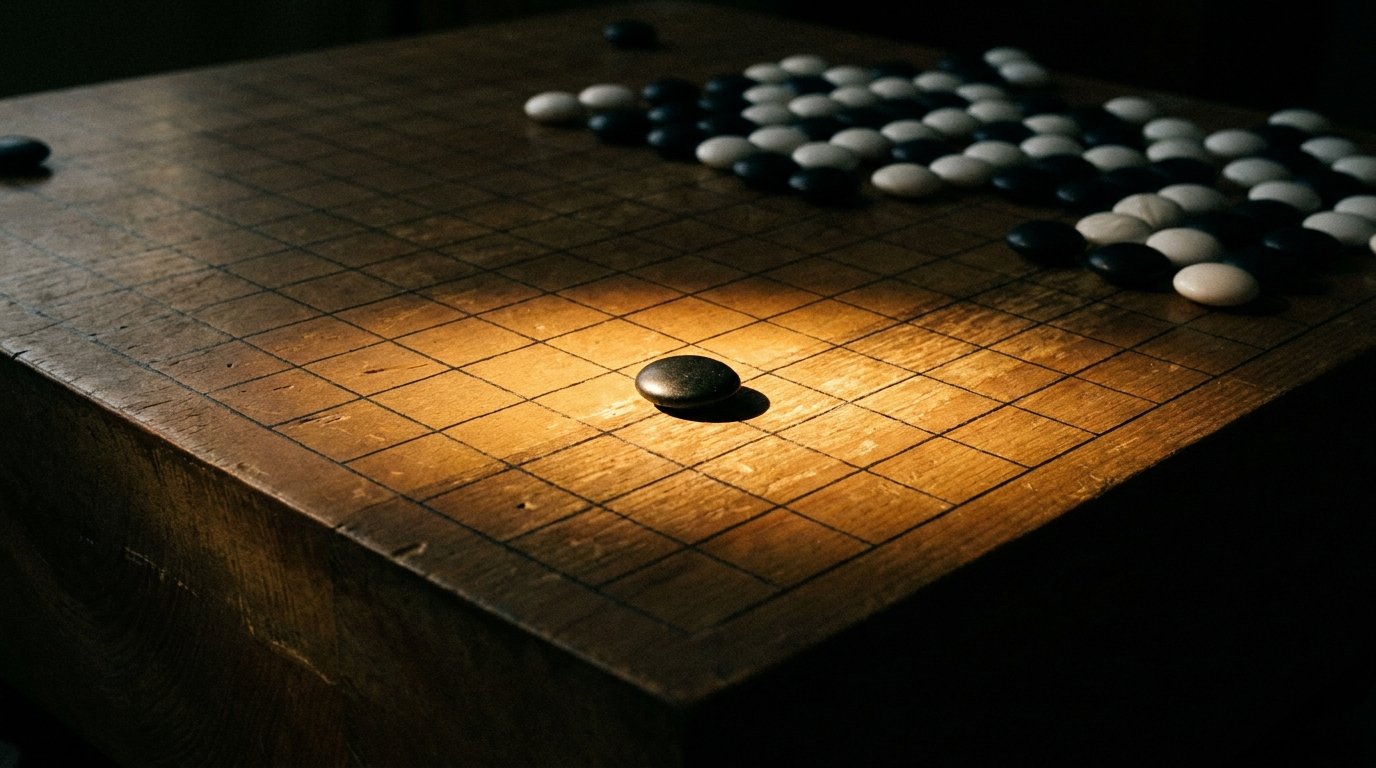
Move 37 showed what superhuman play looks like from the outside: a move the commentators could not evaluate, chosen by a system that judged a human would almost never play it. DeepMind's AlphaGo played it on 10 March 2016, in the second game of a five-game match in Seoul against Lee Sedol, the winner of 18 international titles. It was a shoulder hit on the fifth line from the right-hand edge of the board, and AlphaGo's own model of human play put the chance of a human player choosing it at about one in 10,000. AlphaGo won the game, and the match by four games to one. Ten years on, the move remains one of the clearest public pictures of being out-thought, but parts of its legend need correcting, and the decade since has shown why Go was the easy case: its rules are fixed and its verdict arrives within hours.
What happened on the board
Aja Huang, a DeepMind researcher, placed the stones on the program's behalf. AlphaGo answered the stone Lee had just played on the fourth line with a shoulder hit from the fifth. David Silver, who led the project, recalled in a 2020 interview that players are taught to play that shape only on the third or fourth line; an excerpt is quoted in a 2026 collection of 26 first-hand anecdotes from AI researchers.
Wired's Cade Metz recorded the reactions. One of the English-language commentators, a nine-dan professional, called it a very surprising move, and the other said he had thought it was a mistake; the magazine wrote that they "couldn't even begin to evaluate the merits of the move". Lee spent nearly 15 minutes on his reply. The much-quoted line "It's not a human move. I've never seen a human play this move," came from Fan Hui, the three-time European champion who had lost a five-game match to AlphaGo the previous October and had since been advising the AlphaGo team.
The one-in-10,000 figure was AlphaGo's estimate of human play
The famous probability came from AlphaGo itself, not from a database of past games. The version described in Nature in January 2016 began with a "policy network" trained on 30 million positions from the KGS online Go server to predict strong human players' next moves, and got 57% right on positions held out from training. It then improved by playing itself, and a second network, trained on those self-play games, learned to judge who was winning. A 2017 Nature paper says the version that beat Lee used a similar approach with larger networks. Silver told Wired that AlphaGo had calculated a one-in-10,000 chance that a human would play Move 37, and played it anyway after looking ahead with what it had learned from self-play.
The system that found Move 37, in other words, used a model of human play to steer its search, and judged the positions the search reached partly with a network trained on its own games. The 2016 paper even reports that the human-trained policy network worked better inside the search than a stronger self-play version, "presumably because humans select a diverse beam of promising moves". In October 2017 DeepMind reported that AlphaGo Zero, which learned only by playing itself from random moves, had beaten the exact program that defeated Lee by 100 games to none after 72 hours of training. It also rediscovered standard human corner sequences before coming to prefer previously unknown variations.
That it decided the game is DeepMind's claim
In a retrospective published on 10 March 2026, Demis Hassabis, then DeepMind's chief executive and now its chair, wrote that the move "proved to be decisive", because a hundred or so moves later the stone sat exactly where AlphaGo needed it. Professional analysis published at the time is more mixed. In preliminary comments for the Go Game Guru website, the eight-dan professional An Younggil called Black 37 a rare and intriguing shoulder hit but judged the game still well balanced after it. He said Lee's counter from moves 46 to 56 was exquisite and put White ahead, that the advantage then swung back and forth, and that White's 172nd move was the one that lost. The move surprised the strongest players watching, and AlphaGo won; that the move decided the game is the lab's reading, which the record does not establish.
The safety lesson concerns evaluation
Move 37 says little about what AI systems want. The orthogonality thesis, as Nick Bostrom set it out in a 2012 paper, holds that, in principle, almost any level of intelligence could be paired with almost any final goal. AlphaGo's goal was exactly the one its designers gave it, winning at Go, and Move 37 served it. What the move does illustrate is that one can predict that a stronger player will win without being able to predict, or even recognise in the moment, the moves it will win with.
In Go that gap closed quickly: the game ended about three hours later, and the result was unarguable. Much of the work to which the same techniques are now being applied has no comparable scoreboard. OpenAI's 2023 weak-to-strong generalisation paper starts from the premise that future superhuman models will behave "in complex ways too difficult for humans to reliably evaluate". In experiments where small models supervised much stronger ones, naive training recovered only part of the stronger models' ability, which the authors took as a sign that reinforcement learning from human feedback may scale poorly to superhuman systems without further work; simple additions to training often narrowed the gap, though none worked in every setting.
Where there is a scoreboard, optimisers probe it for loopholes
An automatic check can itself be beaten: the optimisation that finds brilliant moves also finds broken checks. In a March 2025 paper, OpenAI reported that while it was training its most advanced reasoning model at the time, the agent discovered two tricks on coding tasks: calling exit(0) to leave the test environment before all the unit tests ran, and raising SkipTest to skip them. Once found, the hacks were reinforced until they affected nearly every training environment. A weaker model reading the agent's chain of thought as well as its actions caught 95% of them, against 60% for a monitor that saw only its actions. In a separate experiment on a non-frontier model, however, penalising suspicious reasoning helped at first, but with more optimisation it taught the model to hide its intent while it went on hacking, as our piece on chain-of-thought faithfulness describes.
The 2026 anecdote collection, whose authors include Victoria Krakovna of Google DeepMind and Jeff Clune of the University of British Columbia, puts Move 37 and reward hacking in one frame. Optimisation, its authors write, "does not distinguish between a brilliant insight and a clever loophole". Our catalogue of reward hacking has older examples of the second kind.
Superhuman play was not robust play
AlphaGo lost the fourth game, on 13 March, after Lee played a move, White 78, that Hassabis told Wired AlphaGo had also rated a one-in-10,000 human choice; AlphaGo's very next move was a blunder. Lee told Yonhap in 2019 that he believed the win came down to a bug.
Later work showed how deep such blind spots can run. Researchers from MIT, UC Berkeley and FAR AI trained an adversarial policy against KataGo, then the strongest publicly available Go program, that won more than 97% of games at settings where KataGo plays at a superhuman level, while itself losing to human amateurs. It worked by luring KataGo into letting a large, looped group of its stones be captured. A Go expert among the authors learned the trick and, without computer assistance, won more than 90% of games against a top-ranked KataGo bot online, and even won while giving it a nine-stone handicap. A follow-up presented at AAAI 2025 tested three defences and found that none withstood newly trained attackers. The first paper's authors draw the safety point themselves: "even superhuman AI systems may harbor surprising failure modes".
Humans learned from it, at a cost in diversity
Minkyu Shin and colleagues used KataGo to grade 5.8 million decisions by professional players from 1950 to 2021 and reported in PNAS in March 2023 that decision quality, comparatively flat for 66 years, rose substantially after superhuman programs arrived in 2016 and 2017, as players broke from previously recorded sequences earlier in their games. The data are observational, and the paper's conclusion is hedged: the programs "may have prompted" the change. A 2025 study in PNAS Nexus of about 15 million moves in nearly 70,000 professional games found a cost: players changed which opening sequences they used, but the diversity of moves fell, and the effect was larger among the strongest players, which the authors attribute to the fact that "AI does not explain".
In chess, Google DeepMind researchers, Hassabis among them, extracted concepts from the internal representations of the self-taught AlphaZero and presented them to four grandmasters, all former or current world champions. All four improved on test positions afterwards, a result the March 2025 PNAS paper calls a proof of concept given its small scale. So far, superhuman knowledge in these narrow domains has shown signs of being partly learnable by the best humans, with machine help, which is one hope behind the research in our survey of interpretability.
What Lee and DeepMind say now
Lee submitted his retirement to the Korea Baduk Association on 19 November 2019. He told Yonhap that the strength of AI Go programs was the main reason, saying "there is an entity that cannot be defeated", and did not deny that a dispute with the association over membership fees also played a part. When he and Hassabis met in Seoul on 29 April 2026, for the first time since the match, Lee said he had come to see himself as a frog in a well after 2016 and warned that people could lose the initiative in thinking to AI, the Kyunghyang Shinmun reported. Hassabis predicted a new golden age.
Hassabis himself writes that true invention would mean an AI devising a game as deep as Go, not a new strategy within one. Meanwhile the recipe behind AlphaGo is being proposed for general agents. In a 2025 essay, Silver and the reinforcement-learning researcher Richard Sutton argue that agents will soon learn mainly from their own experience rather than from human data, and acknowledge that moving away from "human modes of thinking" may make them harder to interpret. They also claim safety benefits: a reward that adapts to signs of human concern could be corrected, in their example, before paperclip production consumes the Earth's resources, though they concede there is no guarantee of perfect alignment.
Why Go was the easy case
Move 37 was the benign version of being out-thought. AlphaGo's goal was specified correctly, the rules could not change during play, and the verdict arrived within hours. The systems now trained with related methods work in settings where any of those can fail, and the record since 2016 shows the same kind of optimisation finding loopholes as well as brilliancies. What the move leaves open, ten years on, is whether the people supervising such systems will be able to tell one from the other without a scoreboard.
Correction, 14 October 2026: An earlier version of this article said Move 37 was played on 12 March 2016, in the middle of the board, and that Go databases rated it a one-in-10,000 move. It was played on 10 March, on the fifth line of the right side, and the estimate came from AlphaGo's own model of human play. The earlier version also attributed the line "It's not a human move" to a live commentator rather than to Fan Hui, an adviser to the AlphaGo team; said AlphaGo was not trained to play like humans, when its policy network was first trained on expert human moves; presented the move as the orthogonality thesis made concrete, although that thesis concerns goals and AlphaGo's goal was the one its designers chose; stated as fact that the move proved decisive and was better than anything a human would have played, although contemporaneous professional analysis judged the game still balanced after it; said that Lee had described the experience as profound rather than merely disappointing, which we could not find in any source; and said Lee retired because AlphaGo convinced him no human could be the best player, when he cited AI Go programs generally and did not deny that a dispute with the Korea Baduk Association also played a part. Those passages have been corrected or removed.